
Everyone’s thinking of AI adoption as a technology problem. We've put together a guide on the common enablers and barriers to AI adoption in the workplace. With some practical tips for leaders and managers on what they can do to help.
Successful AI adoption isn’t just about people using AI, but how they use it.
Workplaces are investing heavily in AI tools, platforms and pilots. But despite the excitement, adoption often flatlines. The challenge is whether people feel able, motivated and supported enough to use it in their everyday work.
- Do they experiment with AI?
- Do they know where it can help?
- Do leaders actively encourage it?
- Do they understand the limits of what it can do?
These everyday decisions determine whether AI improves performance or wastes time and creates risk. Fundamentally, AI adoption is a behaviour change challenge.
What behaviour change has to do with AI
Behavioural science tells us that consistent action depends on three things working together: people need to be able to do it, want to do it, and have an environment that makes it possible.
To make adoption more likely, we can look at three core drivers of behaviour:
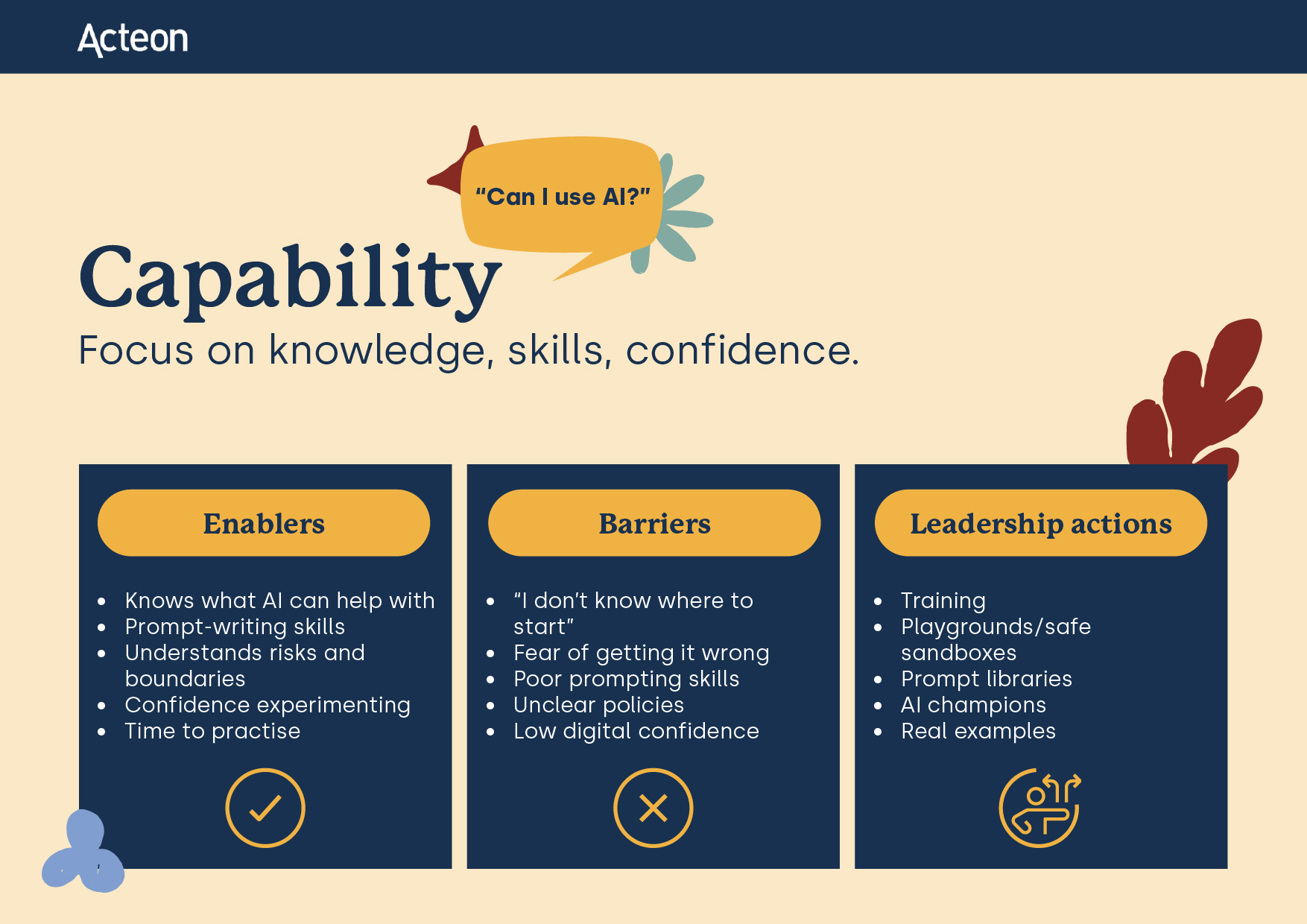
Capability - “I know how to use AI.”
People need the knowledge, skills and confidence to use AI well.
That means:
- Understanding what AI can help with
- Knowing how to write a useful prompt
- Awareness of risks and boundaries
- Confidence to experiment
- Time and space to practise
Common barriers include:
- “I don’t know where to start”
- Fear of getting it wrong
- Poor prompting skills
- Unclear policies
- Low digital confidence
How can leaders and managers support capability?
Leaders and managers play a critical role in building capability through:
- Practical training that mirrors real work
- Opportunities for people to experiment without consequences
- AI champions and peer support
- Sharing real use cases: what worked, what didn't, what surprised someone
Not everyone will be – or needs to be – an AI expert. The goal is to help people feel confident enough to begin.
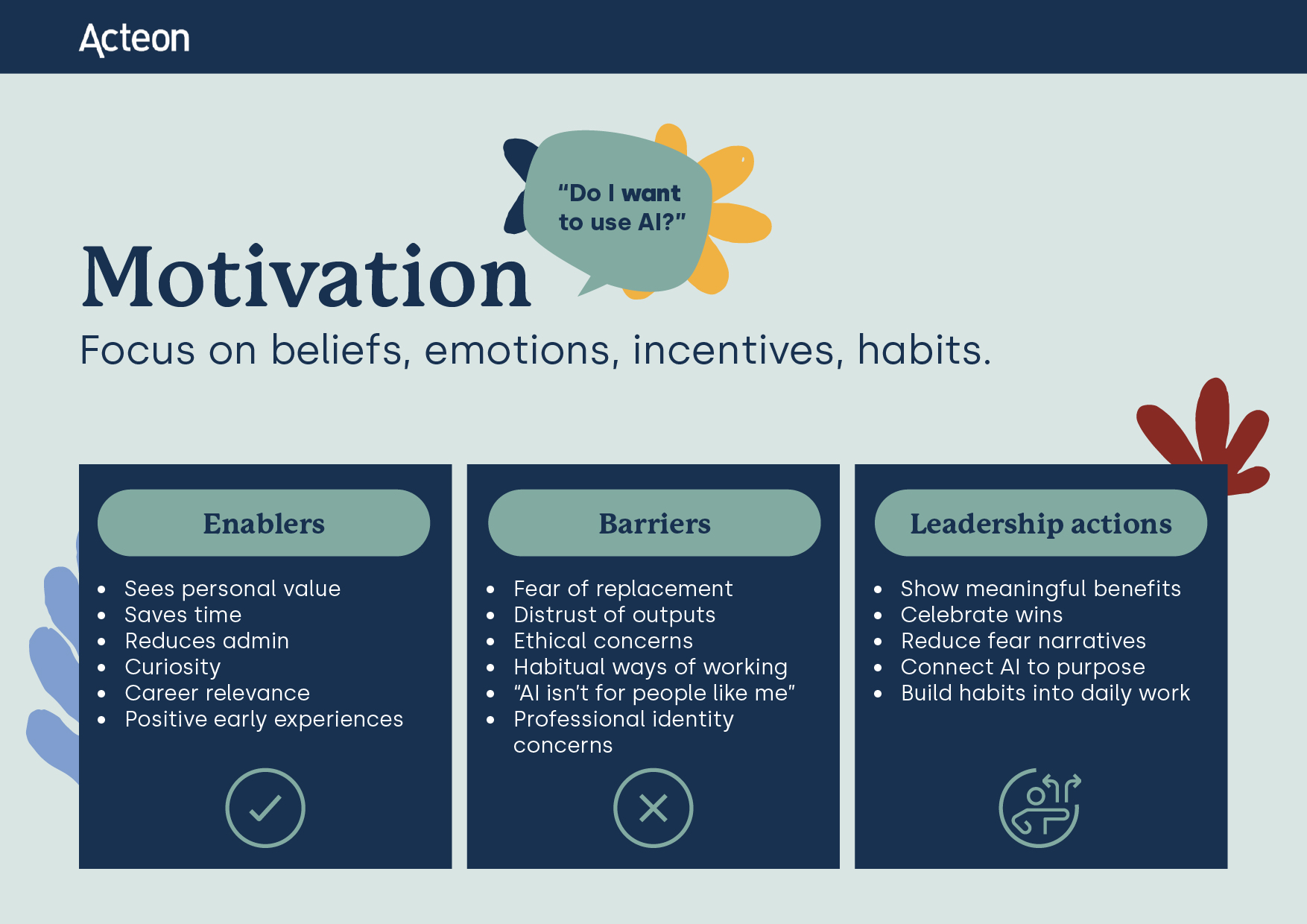
Motivation - “I want to use AI.”
Knowing how to use something isn’t the same as wanting to. Even when people understand AI, they may still resist using it. There are many, varied reasons to be wary, and talking about these openly helps people feel confident in their actions.
Motivation builds when people believe:
- AI will genuinely help them with their work
- Using it will save them time
- They have permission to try
Motivation is heavily influenced by culture and leadership behaviour. If leaders never mention AI, never use it themselves, or talk only about risks, people quickly think ‘this probably isn’t for me’. Likewise, if they’re too optimistic and enthusiastic, people might take a more cautious approach.
Theres a balance here. When leaders are visibly curious, share what they're trying, and learn out loud, effective adoption becomes far more likely.
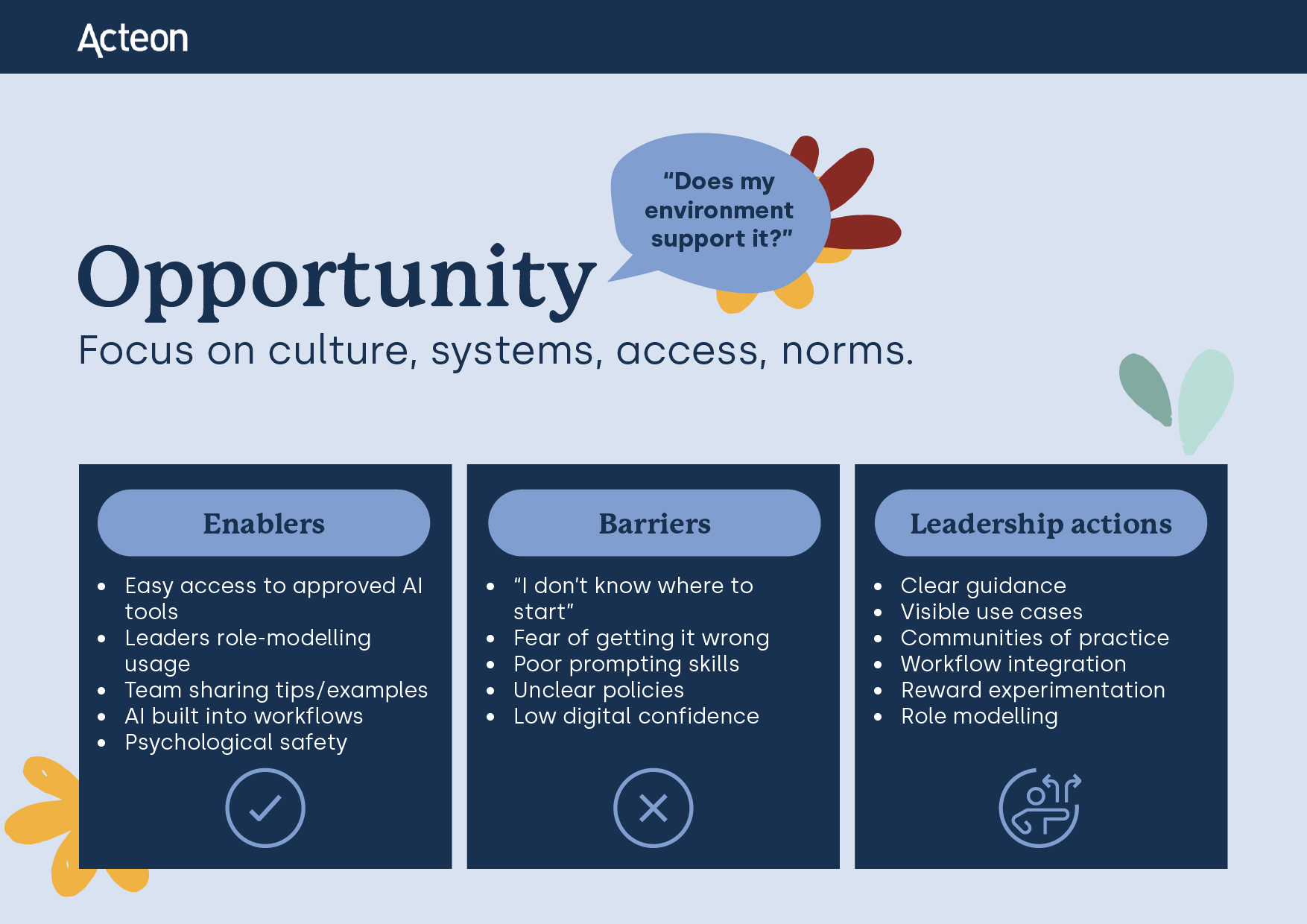
Opportunity - “My environment supports it.”
Capability and motivation aren't enough on their own. People also need the right conditions around them. Even highly motivated employees will struggle to adopt AI if:
- Policies are unclear
- Approval processes are slow
- Access is restricted
- Workloads leave no time to experiment
- Managers discourage experimentation, in subtle or not-so-subtle ways
Opportunity is about designing an environment where AI use feels easy, practical, safe and normal.
The power of tiny habits
Real adoption of a new tool or idea happens when people feel capable, motivated and supported by the environment they work in - and when small actions become everyday habits.
The organisations seeing the greatest impact from AI are the ones creating cultures where experimentation, learning and practical application happen every day.
Everyone’s thinking of AI adoption as a technology problem. But really, it’s a question of changing our behaviour. Because AI isn’t about tech. It’s about people.